|
|
|
Introduction: Every aquarium hobbyist should understand the fundamentals of the nitrogen cycle (sometimes called “new tank syndrome” before entering into the exciting hobby of aquarium keeping. Knowing this cycle will enable both the beginner and the long-term hobbyist to better understand what is going on inside the artificial environment he/she has created. In turn, patience and understanding the basics of this process will go a long way in providing a successful and positive experience in the aquarium hobby.
|
|
The Nitrogen Cycle: |
|
By Mike Hook : HBH Research |

|
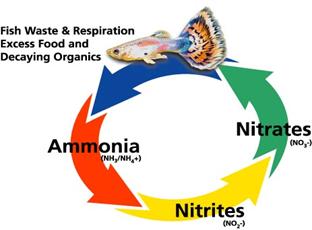
Nitrification is the process by which toxic ammonia (NH3) and non-toxic ammonium (NH4+) are converted into nitrites (NO2-/toxic) and then nitrates (NO3-/non-toxic in low levels). See graphic below for illustrated version of this process.
In aquarium water, the first stage of the nitrogen cycle is where ammonia is produced through the break down of proteins associated with fish wastes (respiration and excrement); excess uneaten food; and other decaying organic matter such as plants and dead fish. It is the conversion or decomposition of these materials that begins the necessary and natural cycle of the home aquarium. If left unchecked, this cycle can be one of the most detrimental. Ammonia is easily and rapidly dissolved in water and can cause many problems very quickly. Ammonia is readily available in a pH over neu |
|
tral (7.0) and increases as the waters pH and temperatures increase. Ammonia produces low levels of ammonium that are relatively non-toxic in comparison. Ammonium is predominantly present in low pH environments (6.9 or less) and doesn’t carry the multitude of problems associated with ammonia but should still be kept in check. Due to high salinity levels, ammonia is 30% less toxic in salt water. Ammonia contributes to many physiological problems in fish and invertebrates. Some of these effects include the reduction of hemoglobin’s ability to carry oxygen to the blood, increased respiration activity (contributing to more ammonia), as well as irritation of the gills caused by ammonia’s attack of the mucus layer. This leads to swelling of the gills and in some cases the formation of new cells on the lamellae (known as hyperplasia) further impairing the up take of oxygen. High levels of ammonia can also lead to the sloughing off of the mucus membrane on both the skin and the intestines creating lesions or external bleeding of the skin and internal bleeding of the organs. The brain and central nervous system can also be damaged with permanent effects. Stress related illnesses have been linked to poor water quality and high levels of ammonia. If ammonia is left to build up in an aquarium, levels can easily rise to become fatal.
Nitrites: The second stage of the nitrogen cycle is the conversion of ammonia to nitrites through aerobic (oxygen dependant) activity of the Nitrosomonas bacteria. Nitrites are less toxic than ammonia but should never be over looked. Fish and invertebrates can experience several devastating side effects due to nitrite exposure, such as, the inability to carry oxygen to the blood by way of the haemoglogin by oxidizing the iron into methaemoglobin. Methaemoglobin has no ability to carry oxygen to the blood and in turn may cause the blood and gills to turn brown and/or die. It also breaks down red blood cells and very high levels may cause nitrite poisoning or death.
Nitrates: The conversion of nitrites to nitrates is the third and, for our purposes, the last step in the nitrogen cycle. This is accomplished by the oxidization of nitrites by Nitrobatcer bacteria species converting it into less harmful nitrates. Nitrates are less harmful than nitrites and most fish seem to be able to withstand much higher levels of this compound. However, nitrates are more toxic to marine life than to freshwater life forms. This is especially important to remember when keeping invertebrates. Discus, Geophagus sp., some dwarfs and African cichlids of the Great Lakes area can also be sensitive to high levels, leading to stress induced illnesses. Fry and eggs of most species can be greatly affected by nitrates even when adults of the same species are not. The presence of nitrates can also lead to stunted growth and stress related illness. Almost all aquarium problems stem from poor water quality and by performing water changes the trouble areas can be reduced significantly.
To be successful with your home aquarium, it is important to regularly test both the tank and replacement water for these compounds (ammonia, nitrites & nitrates) and allow new tanks to cycle for 4-6 weeks as stated in the introduction. After this has successfully taken place, it is important to maintain a regular water changing regimen of 10-30% as often as possible, every other week or at the very least once a month. Along with regular water changes, clean and/or replace filter cartridges, and vacuum substrates and remove accumulated detritus (organic waste buildup). Remember, if your incoming tap water is high in any of the above compounds then it will be necessary to use RO, deionized, or other clean water sources. You can also use various types of removing agents along with skimmers and denitrators. However, nothing beats regular maintenance and paying attention to the aquatic environment you have created.
References: Andrews, Exell, and Carrington (1988) The Manual of Fish Health. Tetra Press, Blacksburg, VA., USA Axelrod, Burgess (1978) African Cichlids of Lakes Malawi and Tanganyika. TFH Publications, Neptune City, NJ., USA Green (Jan, 1998) Treaing the Problem. Aquarium Fish Magazine, Mission Viejo, CA., USA Hovanec (June, 1996) Water Quality – Freshwater. Aquarium Fish Magazine, Mission Viejo, CA., USA Hovanec (Dec, 1996) Nitrifying Bacteria – Part 1. Aquarium Fish Magazine, Mission Viejo, CA., USA Hovanec (Jan, 1997) Nitrifying Bacteria – Part 2. Aquarium Fish Magazine, Mission Viejo, CA., USA Hovanec (Aug, 2000) The ABC’s of Filtration. Aquarium Fish Magazine, Mission Viejo, CA., USA Loiselle (1985) The Cichlid Aquarium. Tetra Press, Morris Plains, NJ., USA Meyer (June, 1996) Water Quality – ponds. Aquarium Fish Magazine, Mission Viejo, CA., USA Meyer (Nov, 2000) Pondering Water Testing. Aquarium Fish Magazine, Mission Viejo, CA., USA Meyer (Dec, 2000) Biological Pond Filtration. Aquarium Fish Magazine, Mission Viejo, CA., USA Miller (Aug, 2000) A Filter is a Filter is a… Aquarium Fish Magazine, Mission Viejo, CA., USA Mills (1986) You & Your Aquarium – A Complete Guide to Collecting and Keeping Aquarium Fishes. Borzoi Book, NY., USA Morgan (Aug,1999) Testing the Water. Aquarium Fish Magazine, Mission Viejo, CA., USA Skomal (1997) Setting up a Freshwater Aquarium. Howell Book House, New York, NY., USA Sprung (June, 1996) Water Quality – Saltwater. Aquarium Fish Magazine, Mission Viejo, CA., USA Riehl (1996) Aquarium Atlas 1. Mergus (Baensch), Melle, W. Germany & Tetra Press, Blacksburg, VA., USA Halstad (1999) Ecology of the Planted Aquarium. Echinodorus Publishing, Chapel Hill, NC., USA |
|
The Nitrogen Cycle |